Gallup's 2026 State of the Global Workplace report found that global employee engagement dropped to 20% in 2025. Fragmented tools, inconsistent reach, and programs that never make it into employees' daily routines are a significant part of why those numbers look the way they do.
Company culture software can help deal with the engagement problem by bringing communications, recognition, answers, and feedback into one platform. But these platforms differ sharply in what they prioritize. Some lead with pulse surveys and analytics. Others are built around peer recognition, frontline reach, or internal comms publishing.
The right option depends on what you're trying to do: whether that's making recognition a consistent habit across a distributed workforce, giving employees a reason to stay connected to the organization beyond their immediate team, or turning leadership communication into something people actually read and respond to.
This guide breaks down the 10 best company culture platforms by what they do, who they fit, and where they fall short, so you can match the right platform to how your team already works.
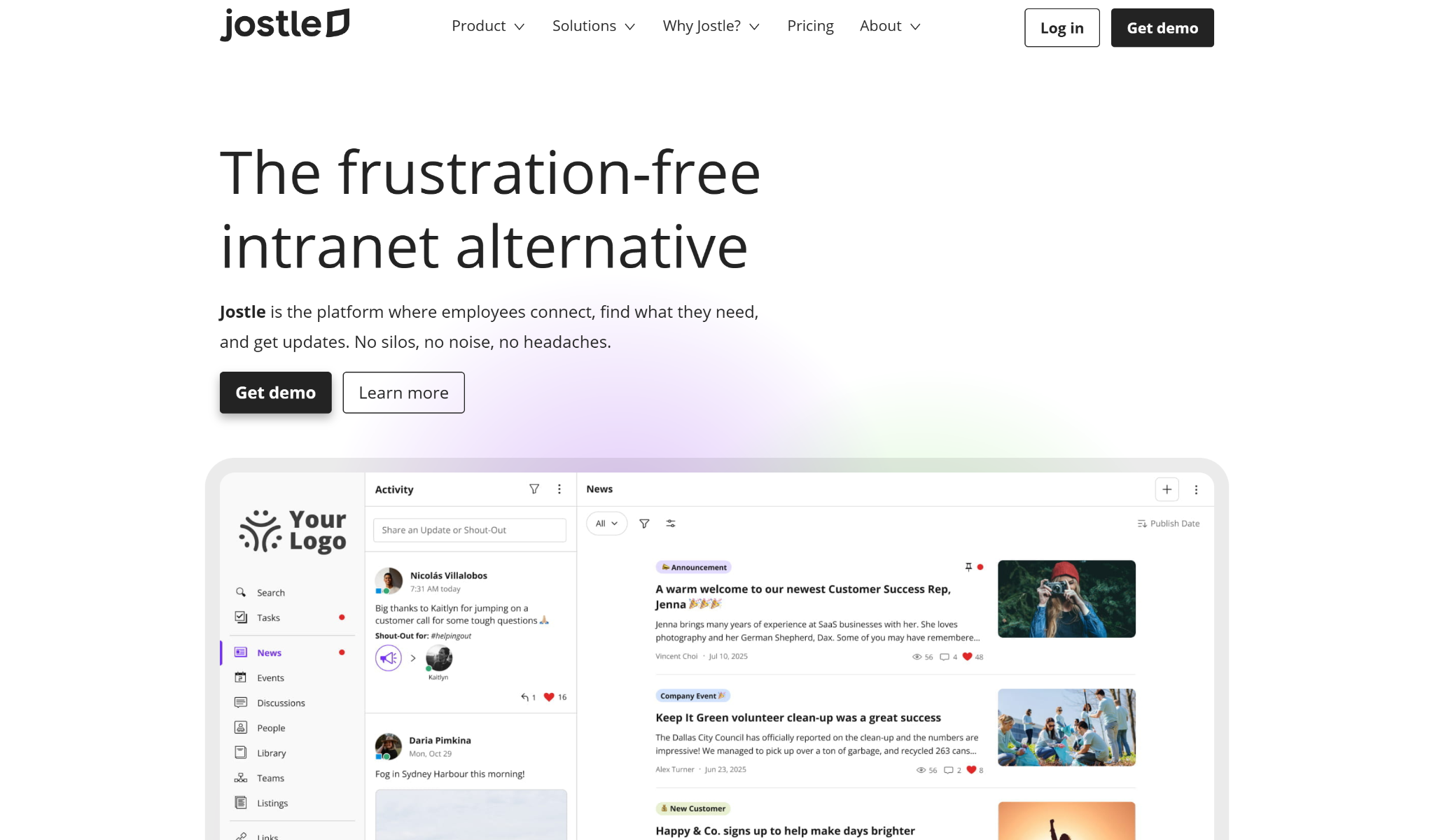
Getting culture to show up consistently across a distributed workforce is harder than it sounds. Jostle approaches it by keeping recognition, communication, and connection in the same place employees already go for updates and announcements, so participation doesn't require a separate login or a reason to remember another tool exists.
The Activity feed is where the culture layer lives day to day. Team wins, peer appreciation, and company milestones show up here in a dedicated space, separate from official announcements, so neither competes with the other for attention.
Shout-Outs let employees recognize colleagues publicly and tie that recognition to specific company values. Work anniversaries and birthdays also populate automatically, keeping those moments visible without depending on anyone to track them manually.
That balance between automated posts that encourage interaction and genuine employee-to-employee moments means the Activity feed stays active and relevant even during quieter periods, without communications teams having to manufacture reasons to post.
Communication in Jostle reinforces culture by making sure the right messages reach the right people.
News targets updates by role, department, or location, so employees consistently see updates that are relevant to them instead of irrelevant broadcasts that never get read. And for messages that really matter, like a leadership update or a major operational change, sign-off tracking confirms they were read, not just delivered.
For truly urgent updates, Notify pushes posts to the employee both on and off the platform, including into Microsoft Teams or Slack, so nothing important gets missed between check-ins.
Keeping employees connected to the organization also means making it easy to find the right person quickly.
The People directory is searchable by name, role, department, and location, so a new hire looking for the regional safety lead or a project manager trying to find the right finance contact doesn't have to ask around. Teams org charts extend that further, showing reporting lines and department structure in a way that's useful for cross-functional work, especially when the formal hierarchy is hard to understand from a job title alone.
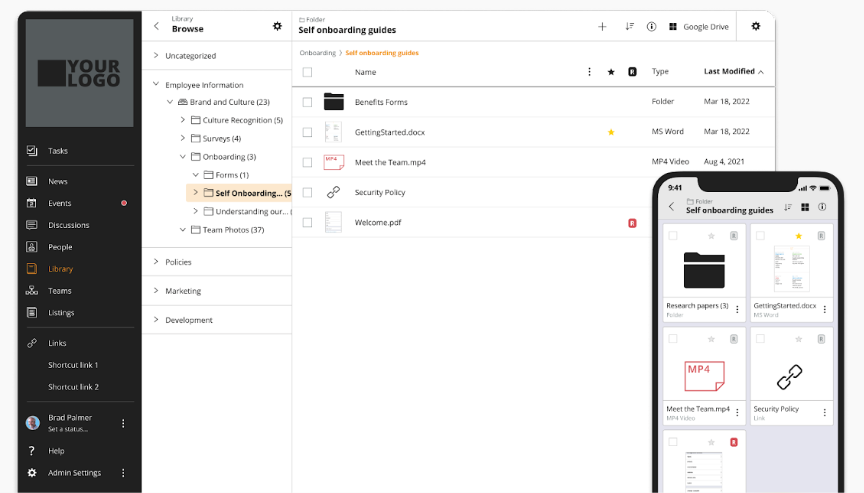
The Library gives employees one place to find current policies and resources, with permissions that update automatically as roles change rather than requiring manual access management. But if team members still can’t find what they’re looking for, JostleAI's Ask a Question can search that curated content and return answers scoped to each employee's role and location, so international employees don’t get US parent leave policy information.
Not everyone logs in every day. But that’s what the Weekly Digest is for. It sends a personalized recap of recent News, Shout Outs, and other events directly to employees’ inboxes, helping to keep anyone off-platform up-to-date. For employees who aren’t working at desks, JostleTV brings recognition and updates into shared physical spaces like break rooms and production floors. Together, they extend the same culture and communication experience to employees regardless of how or where they work.
Jostle is a perfect fit for organizations that want culture to be a consistent, visible part of how employees experience work every day. It promotes participation more naturally over time since everything lives in the same place employees already use. Jostle is also relatively quick to roll out, and with onboarding support included, gaining that initial traction is easy.
Pricing depends on the number of users and the functionality you require. For example, People is included with all plans, while Teams is an add-on option available with Silver or higher-tier plans.
For 500 users:
Every plan also includes mobile apps, free onboarding and coaching, governance controls, SSO and provisioning, integrations (including Google Workspace and Microsoft 365), AI features, and more.
G2: 4.6/5 – Based on 222 reviews
Capterra: 4.4/5 – Based on 74 reviews
“Jostle is really user friendly. It's visually easy to navigate and find what you are looking for. The design and structure of the platform supports our corporate vision and the content libraries are easy to find and upload articles to. Our staff are really enjoying the overall experience and becoming more interactive with it.” — Verified G2 User
“Jostle was so easy to set up, we had it up and running in two weeks! Jostle has all the functions we needed as a business. We now have the perfect platform to share all the latest company news. A place where we have all our important information stored in one central location, and most important to us, Jostle has provided a platform to bring us all back together whilst we navigate the new world of hybrid working.” — Verified G2 User
Culture Amp helps teams run structured listening programs, connect feedback to performance and development workflows, and gives managers insights they can act on rather than HR interpreting results and pushing them down manually.
The platform has over 40 templates designed by organizational psychologists that cover everything from annual census surveys to onboarding checks. These templates help turn surveys into something actionable instead of just a bunch of scores. Benchmarking adds another comparison layer and helps separate internal issues from broader market trends.
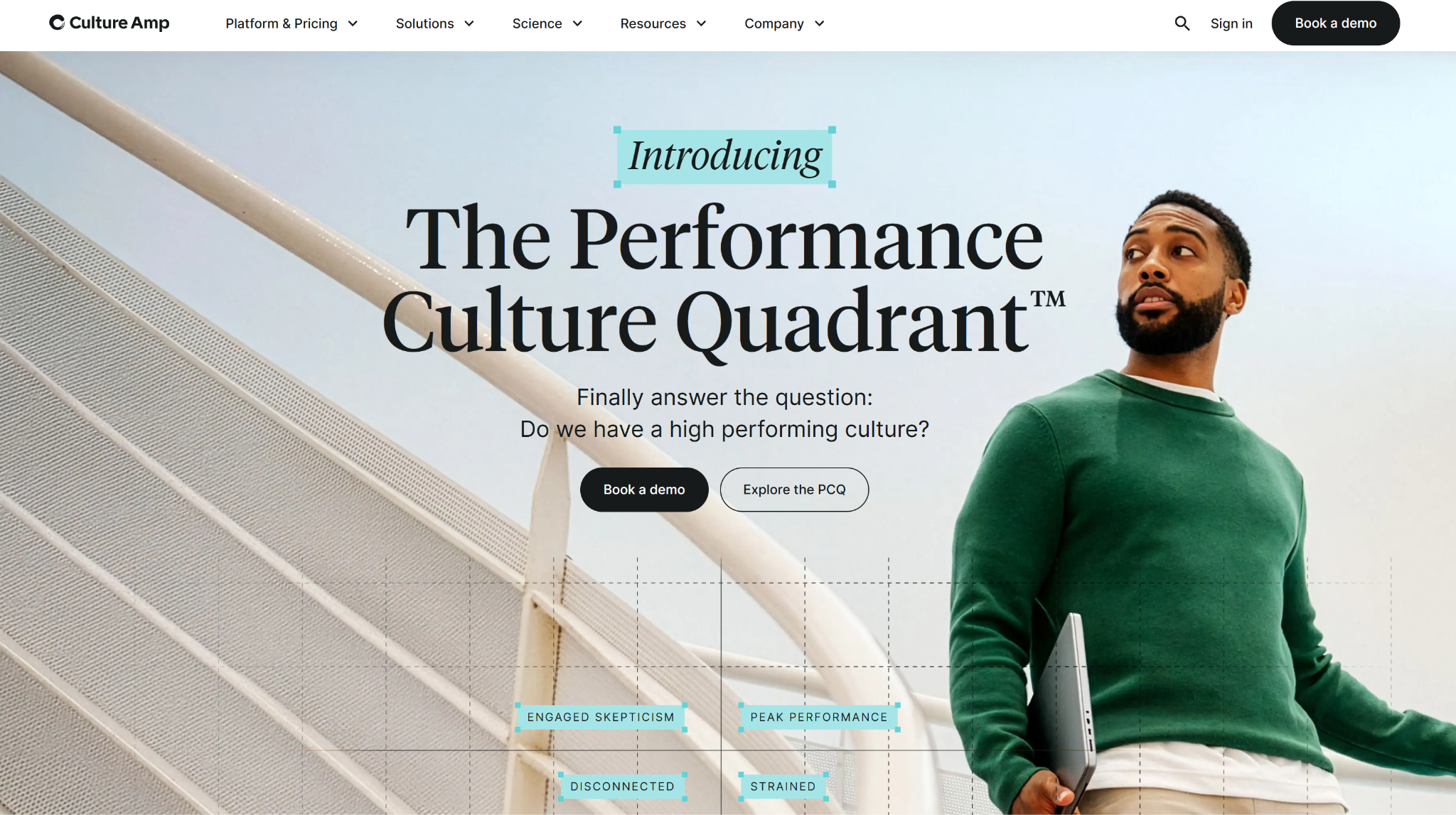
Culture Amp connects feedback to performance and development. The Performance Culture Quadrant plots engagement against performance data, making it easier to identify high performers starting to disengage, or motivated employees who aren’t getting the growth opportunities they need to further their careers.
Three-sixty reviews with calibration sessions bring peer and manager feedback into the same ecosystem, and career pathing tools let employees see realistic progression routes while development analytics track whether skill gaps are actually closing over time.
When you need help translating survey results into recommended next steps for managers, Culture Amp’s AI Coach, which shortens the gap between data collection and on-the-ground action considerably, can help. In organizations where follow-through is inconsistent, that kind of direct nudge matters more than a well-designed dashboard that only HR ever opens. There’s also a lightweight recognition layer built in, so day-to-day appreciation feeds back into engagement data instead of living in a separate system.
Culture Amp isn’t the best fit for small teams, though. Organizations under roughly 200 employees often run into friction with the level of setup and ongoing management required.
Configuring surveys, managing review cycles, and interpreting the data can quickly overwhelm small HR teams. That overhead is easier to manage with dedicated ownership, like a people analytics or HRIS lead, but most smaller companies don’t have that.
Culture Amp may work for mid-market and enterprise teams that want engagement, performance, and development connected through a single analytics layer. If the goal is a lightweight pulse tool, or if there isn’t time to act on detailed feedback, it can feel like more platform than necessary.
Culture Amp pricing is quote-based and typically depends on employee count, modules selected, and service level. Products are billed annually, and organizations can buy modules individually or bundle them.
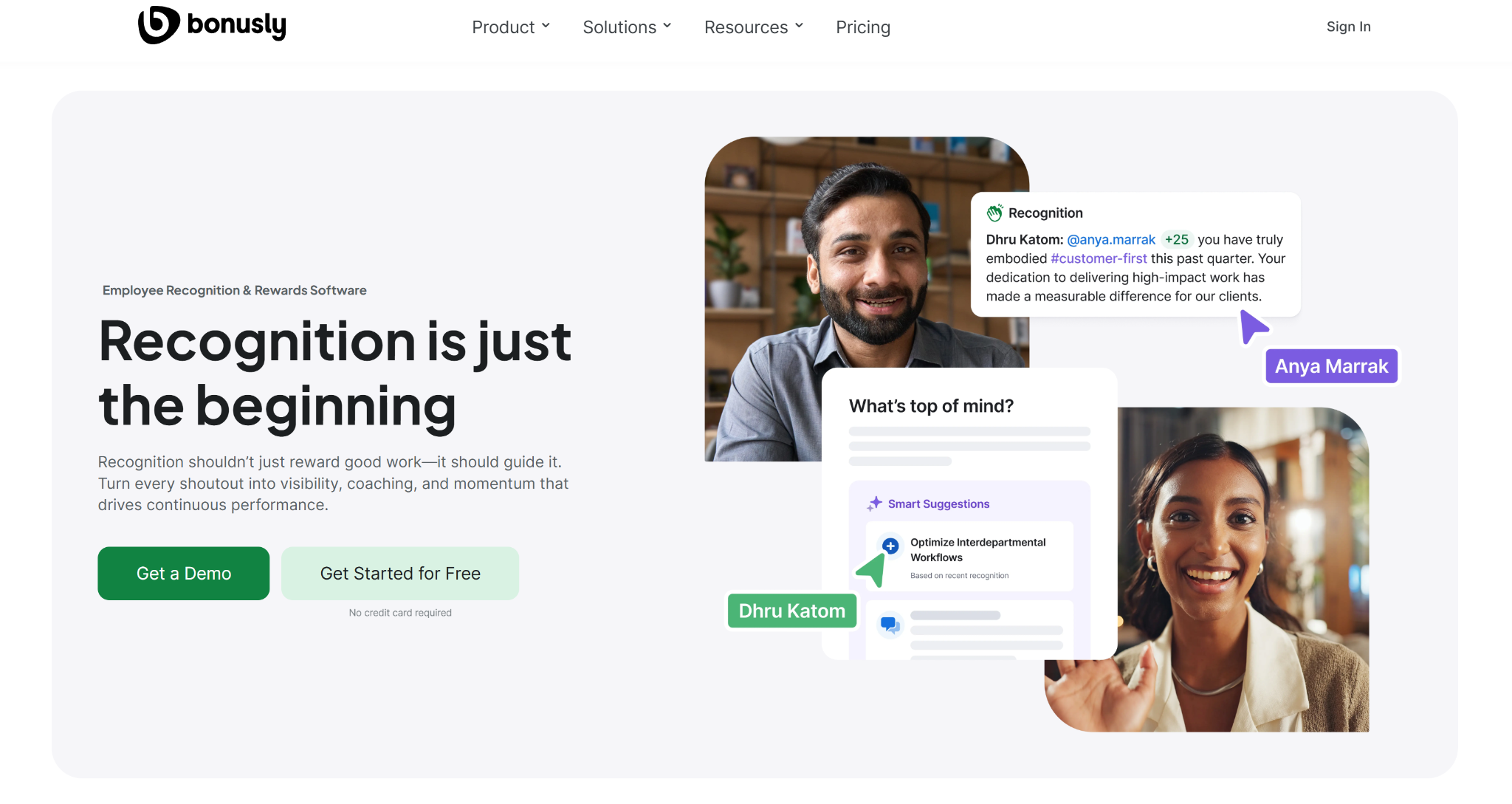
Bonusly started as a recognition platform and has since expanded into continuous performance, with manager tools, goal tracking, and weekly check-ins built on top of that core recognition layer.
That means appreciation feeds directly into performance conversations, encouraging managers to coach in the moment rather than waiting for a quarterly review to reveal what's already visible.
Recognition happens inside Slack or Teams, where employees attach points to shout-outs tied to company values. Those points convert into rewards from a catalog of 1,200+ options across 200+ countries, including gift cards, charitable donations, and company swag. A low barrier to participation is the point: recognition tools only shape culture if people use them consistently, and keeping the action inside tools employees already have open removes the biggest reason they don't.
Bonusly Achieve makes 1:1s more contextual for managers by giving them a running view of each team member’s recognition history, goal progress, and meeting notes before every 1:1. Employees rate their week and add context ahead of each check-in, and AI-generated prompts pull from that activity to help managers follow up on what actually matters.
Bonusly's constraints are mostly about depth. Teams that need structured review cycles, detailed engagement survey programs, or advanced people analytics will find Bonusly lacking in those areas.
There’s also the per-user pricing that adds up at larger headcounts and the rewards catalog that requires ongoing budget oversight to stay meaningful, which can work against each other in delivering value to both employees and the organization as a whole.
Bonusly works best for teams that want recognition to be frequent and visible, without overhauling the entire HR stack. But if you’re looking for a system to manage performance and engagement end-to-end, Bonusly isn’t for you.
Bonusly offers a free plan, a standard Team plan, and custom plans for larger organizations.
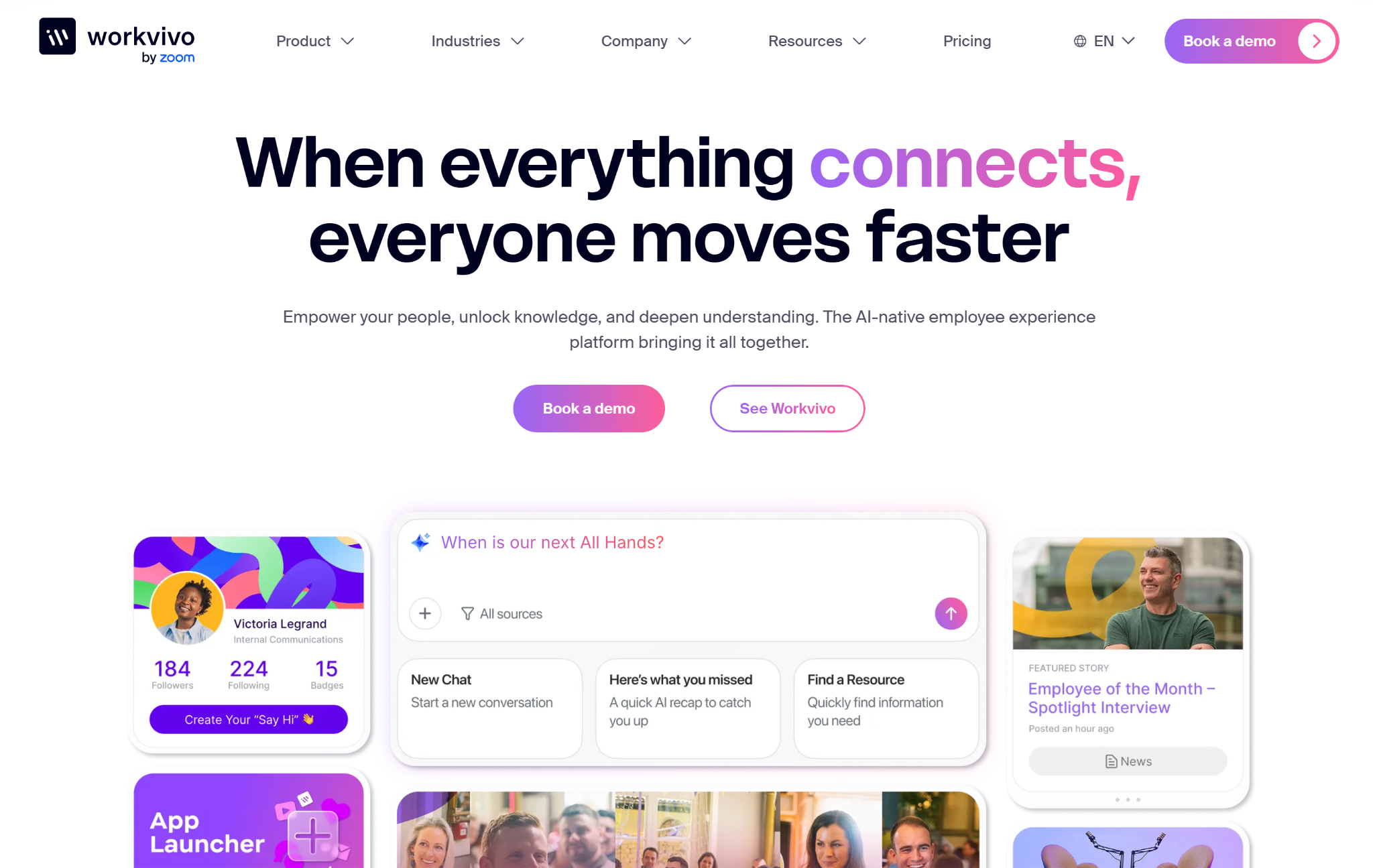
Workvivo is designed for companies in retail, healthcare, logistics, and other industries where a significant share of the workforce works in the field, on the floor, or across rotating shifts. The platform is accessible via a social-style mobile app that feels intuitive from day one, driving the kind of voluntary daily adoption that more formal platforms rarely achieve at that scale.
Recognition, leadership updates, and day-to-day moments all show up in a shared social feed. It’s just part of what employees see when they open the Workvivo app, so appreciation doesn’t get buried or separated into its own system.
Leadership communication follows the same pattern. Instead of relying on static updates, teams can use live streams or podcasts to reach employees more directly. And Workvivo’s ability to translate across 90+ languages ensures those messages land in each employee’s preferred language.
Getting culture to stick across thousands of employees in different locations requires consistent, well-timed communication. Workvivo supports consistency with campaign management tools that let internal comms teams plan, sequence, and target messages across push notifications, in-app feeds, and email from one place.
Workvivo also supports consistency on the HR front with AI-powered sentiment analysis that gives HR teams a real-time read on how morale shifts across facilities or regions. And Employee Journeys automate the communication sequences around onboarding and role changes that tend to be inconsistent at enterprise scale, helping shape how employees feel about the organization early on.
Unfortunately, the constraints are significant for smaller organizations. Workvivo's Business plan starts at a 250-seat minimum, often reaching $20,000 or more per year, which makes it a difficult fit outside of enterprise budgets. There’s also a governance cost to consider. As headcount scales, the feed can become noisy without clear ownership of who publishes what, forcing culture moments to compete with other updates for attention in the same scroll.
Workvivo fits large enterprises where frontline employees have historically been the last to feel connected to company culture, and where closing that gap requires a platform they'll actually open on their own.
Workvivo uses quote-based pricing tied to employee count and plan tier, with two main packages and several optional modules teams can add based on scope.
Includes everything in the Business plan, plus:
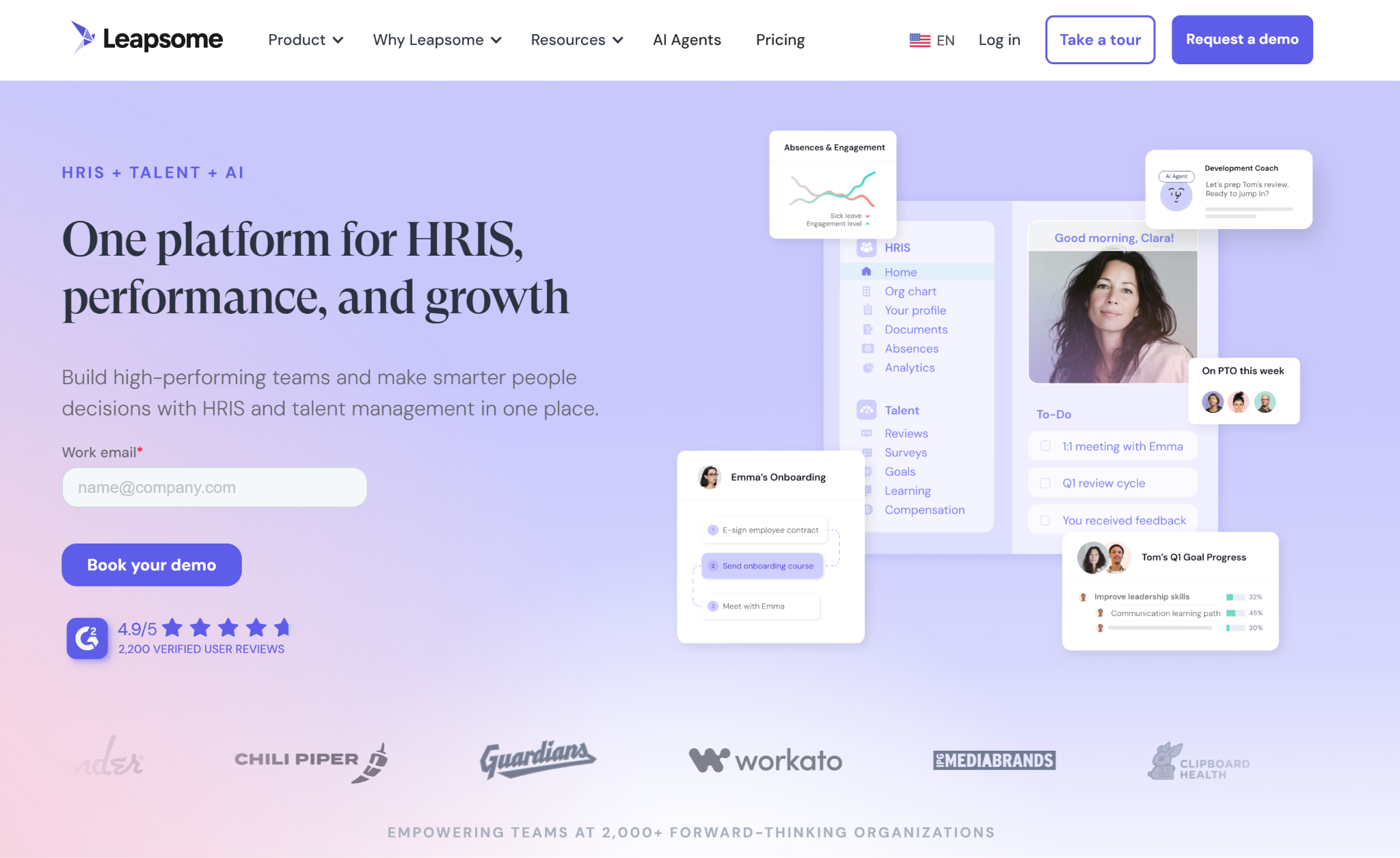
Leapsome is a people enablement platform that connects performance management, engagement, learning, and compensation in one modular system. The platform is less about social feeds or recognition programs and more about building the feedback habits, development structures, and goal alignment. The idea is that if those systems are working, employees feel invested in their work and clear on how their contributions connect to something larger.
That connection shows up in the performance layer. Reviews, goals, and feedback are all tied together instead of running as separate processes. Managers can start with AI-generated feedback and refine it, which removes a lot of the friction that usually slows review cycles down.
Goals and OKRs follow the same logic. They cascade from company objectives down through teams and individuals, so employees can see how what they do connects to bigger priorities. Peer-to-peer feedback and praise sit alongside formal review cycles, so recognition isn't confined to annual moments.
On the engagement side, the platform offers engagement surveys that use AI-powered sentiment analysis to cluster themes across open-ended responses, turning qualitative comments into prioritized patterns HR teams can act on. Similarly, pulse surveys catch shifts in sentiment before they show up as attrition. Then the system consolidates survey responses, reviews, and feedback into one place for managers, which meaningfully reduces the time between insight and follow-through.
Configuration overhead is the biggest tradeoff here. Adopting multiple modules takes time, and keeping those surveys and reviews running requires someone to actively manage them.
Leapsome fits mid-market and enterprise HR teams that want performance, engagement, and development data to inform each other. This allows managers to make coaching decisions using the same data that HR is using to make retention and promotion decisions.
Leapsome offers a 14-day free trial for its plans, but doesn’t list pricing publicly. Quotes are by request only.
Plans are modular, allowing teams to build their own stack within Leapsome, without paying for features they won’t need.
These modules include:
There are also add-ons:
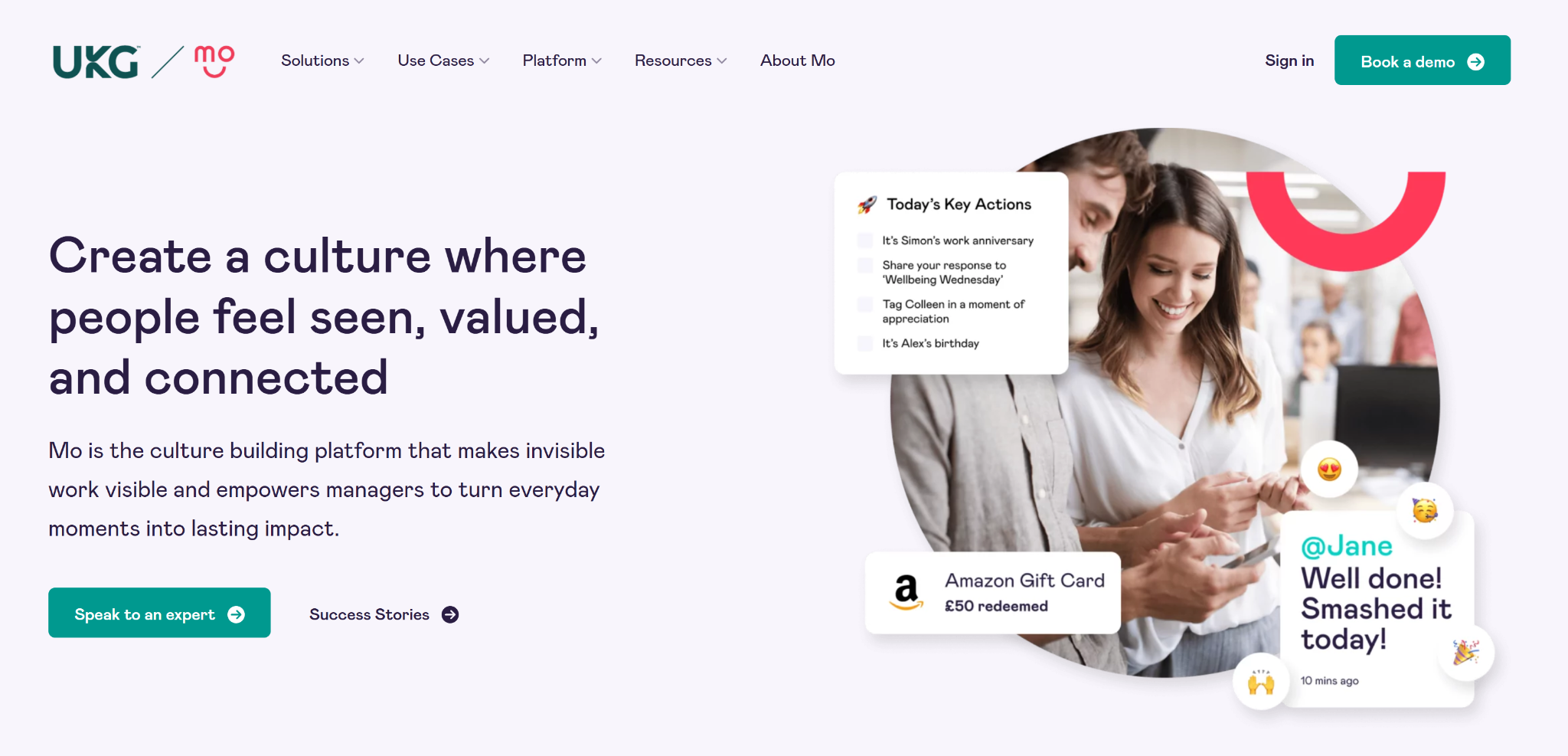
Mo is built around a pretty common reality. When things get busy, recognition is one of the first things to get deprioritized. By the time a strong quarter ends or a difficult project wraps, the moment to recognize it has often passed. Mo steps in at the right moment with smart nudges, automated rituals, and milestone triggers to keep recognition consistent without depending on the manager’s memory.
Mo has several capabilities to promote prompt recognition. The AI Assistant monitors team activity and prompts managers to recognize contributions at the right moment, so a strong project delivery or a difficult week handled well doesn't quietly pass without acknowledgment. At the same time, Mo handles milestones like birthdays and work anniversaries automatically through HRIS data to keep celebrations consistent even as headcount grows.
For more structured recognition, Mo includes awards and nominations tied to company values, with approval workflows that give leadership visibility into what’s being recognized across teams. There’s also a rewards marketplace built without markups on gift cards or experiences, which makes a difference over time if recognition is tied to a budget.
Like most recognition tools, Mo integrates into Slack, Microsoft Teams, and SharePoint so it shows up where people are already working. HR teams can also use the platform’s analytics dashboards to identify participation gaps and recognition frequency trends before disengagement takes hold.
Mo is purpose-built for recognition rather than a full employee experience suite. If you also need engagement surveys, performance reviews, or goal tracking, you’ll need a second platform. Analytics are also useful for recognizing trends but don't reach the depth of dedicated people analytics tools.
However, you might still consider Mo if your team’s recognition is inconsistent and tends to depend too heavily on individual managers or you want something lightweight to build habits before you layer on a broader engagement platform.
Mo does not list plans or pricing publicly. All plans require a custom quote.
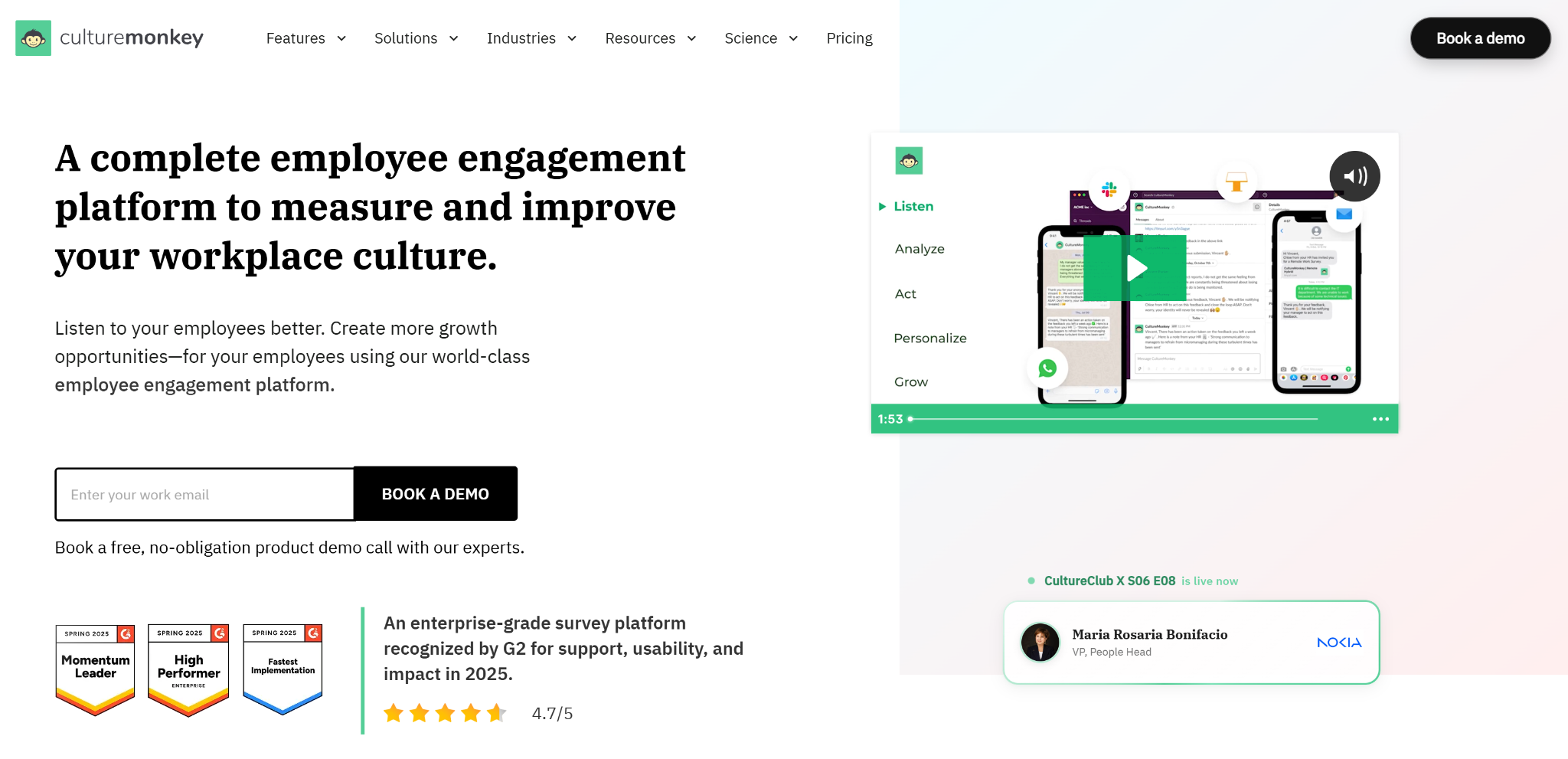
CultureMonkey is an enterprise-grade engagement survey platform for HR teams that need honest, representative feedback from workforces spread across geographies, languages, and work environments.
To allow frontline, factory, and distributed employees to respond through whatever channel they actually use, CultureMonkey allows users to run surveys across Slack, Teams, WhatsApp, SMS, QR codes, and kiosk mode. Even if your team members prefer different languages, support for 150+ languages ensures global teams can respond in their native language rather than a translated approximation. This tends to produce more authentic feedback and meaningfully higher completion rates than email-only alternatives with multilingual workforces.
There are 50+ templates covering everything from eNPS to onboarding and exit surveys, so in most cases, users never have to build surveys from scratch.
The platform makes interpretation as easy as creating surveys. Open-ended survey responses are grouped using sentiment analysis, turning large volumes of comments into clear themes HR teams can act on. From there, heatmaps break results down by team, location, manager, or demographic, making it easier to spot where issues are building.
That said, CultureMonkey is a survey and listening platform. Recognition, rewards, and goal alignment aren't part of the package, so organizations that want those capabilities will need additional tools. The platform is also most valuable once there's internal capacity to act on what surveys uncover. A lean HR team will find it hard to follow through and take action on those insights.
CultureMonkey fits multinational and multilingual organizations whose primary culture challenge is getting honest, representative feedback from every corner of the workforce. If participation has been uneven or limited to certain groups, CultureMonkey might be worth considering.
CultureMoney offers custom-tailored plans for various organization sizes and with multiple types of features included. There’s no official pricing; quotes require contacting them directly.
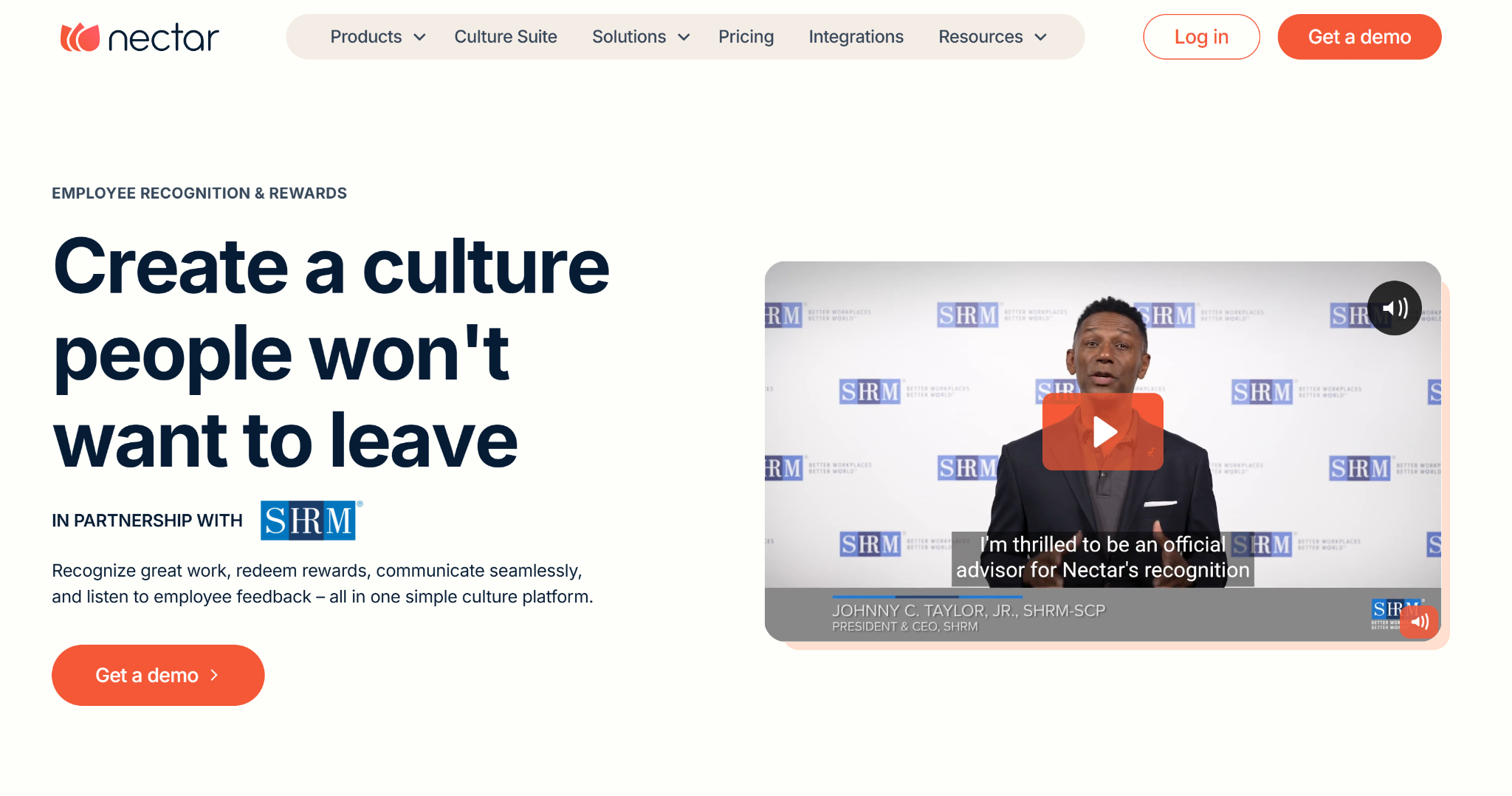
Nectar sits somewhere between a recognition platform and a lightweight employee experience platform. It pulls recognition, communication, and feedback into one place, eliminating the need for mid-sized teams to manage multiple tools.
Nectar keeps recognition visible by allowing employees to send shout-outs within Slack or Teams. Employees can convert these shout-outs into points and redeem them for rewards like gifts cards, donations, and more. Automated milestone celebrations for birthdays, anniversaries, and tenure dates also keep those touchpoints consistent without HR manually tracking dates or drafting messages each time.
Nectar has a few lightweight communication and feedback tools as well. For example, Nectar Comms lets teams send updates across email, Slack, and Teams from one place, so important messages appear alongside recognition instead of in a separate system. Nectar Engage adds pulse surveys, eNPS tracking, and SafeTalk anonymous dialogue, connecting recognition activity to real-time sentiment data rather than treating them as separate programs with separate owners.
Analytics are basic. They cover participation rates, values alignment, and recognition patterns, but don't extend to the strategic workforce reporting that dedicated people analytics platforms provide. For teams whose primary goal is making recognition consistent and visible rather than measuring its downstream impact on retention or performance, that's rarely a limiting factor. If deeper insights are important to making recognition work, a heavier tool usually works better.
Nectar is suitable for growing teams that want peer recognition, internal communications, and lightweight listening consolidated in one place, without the implementation overhead or administrative complexity of platforms built for more specialized programs. It’s a good middle ground for teams that have outgrown ad hoc recognition but aren’t ready to commit to a more complex system.
Nectar doesn’t provide pricing, but lists their core modules and common bundles to help organizations choose their own.
These modules include:
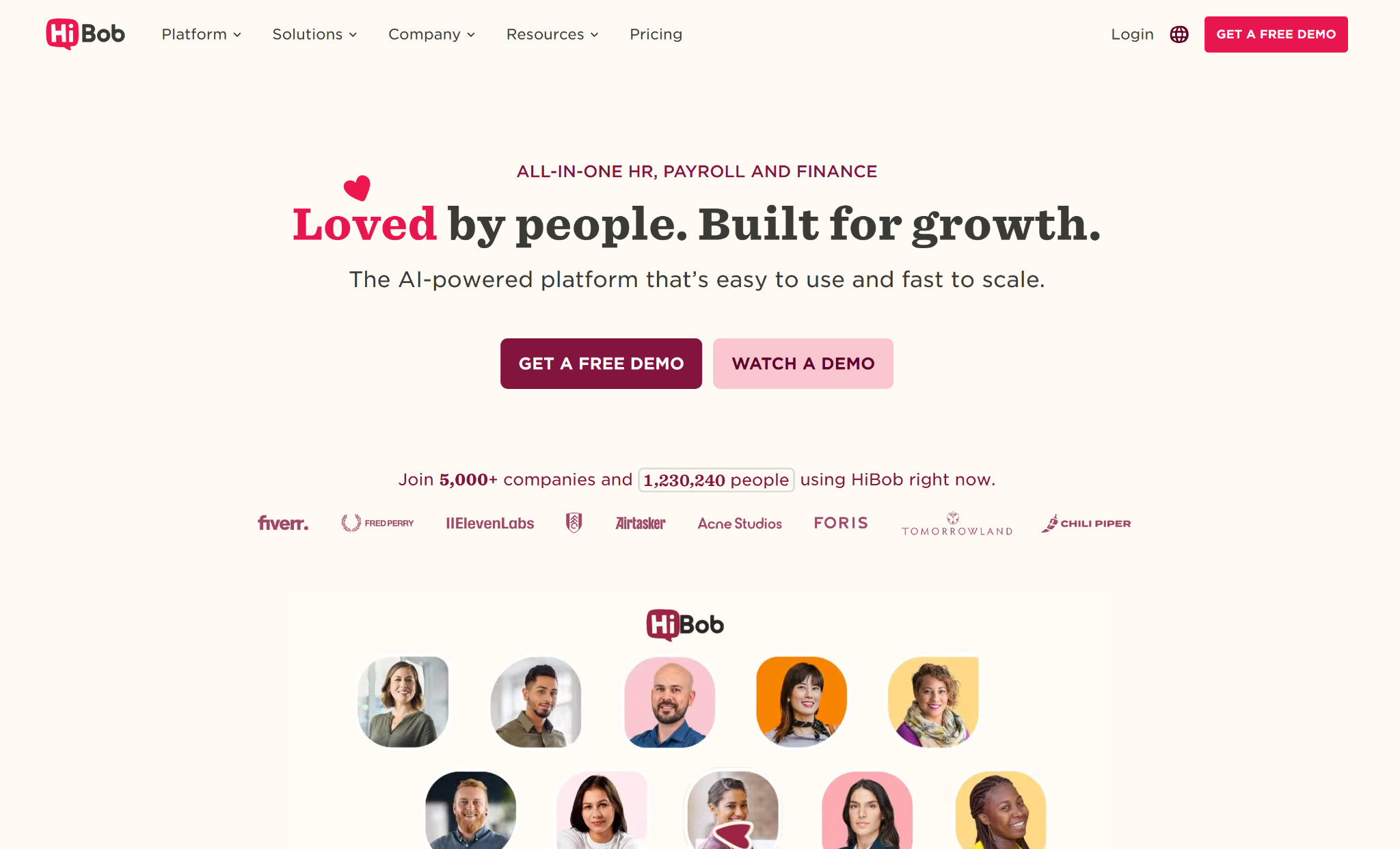
HiBob is an HRIS platform with built-in culture visibility. Kudos recognition, interest-based Clubs, and a social feed sit alongside employee records and compensation management, so employees experience culture as part of daily interactions.
HiBob brings all data, including payroll, engagement surveys, and performance management, into one system. It also supports global teams and localized compliance across 180+ countries. This gives teams a clearer view of workforce health without having to stitch together data from different tools.
Culture visibility runs through the platform's social feed and Clubs, where employees connect around shared interests and team moments alongside company updates. New hires land in that environment from day one, helping remote employees build a sense of belonging before they've had the chance to meet colleagues organically. Additionally, onboarding workflows automate document collection, task assignments, and preboarding sequences, reducing the manual coordination that typically falls on HR during a new hire's first weeks.
Performance management supports 360-degree reviews and goal tracking tied directly to compensation decisions, and the Compensation Hub handles global pay cycles, equity grants, and multi-currency calculations in one workspace.
Most issues users run into with HiBob are related to reporting. It gives you a solid view of core HR metrics and is fine for simple HR data lookups. But if your team is used to more advanced analytics tools, they’ll run into limitations quite often. For example, building complex cross-filters isn’t as quick and easy as you’d want, especially when combining compensation, performance, location, and custom-field data in one report.
It also doesn’t offer snapshot-based reporting, so it’s difficult to get a view of everyone's salary accurately on a specific date. Some of these problems are solvable with manual work, but that effectively breaks the single system advantage.
HiBob works best for mid-market teams that want HR, culture, and performance in a single system. If culture initiatives haven’t gained traction because they lived outside day-to-day workflows, this approach tends to work better.
HiBob doesn’t provide pricing or plan information on their site. Contact them for more information.
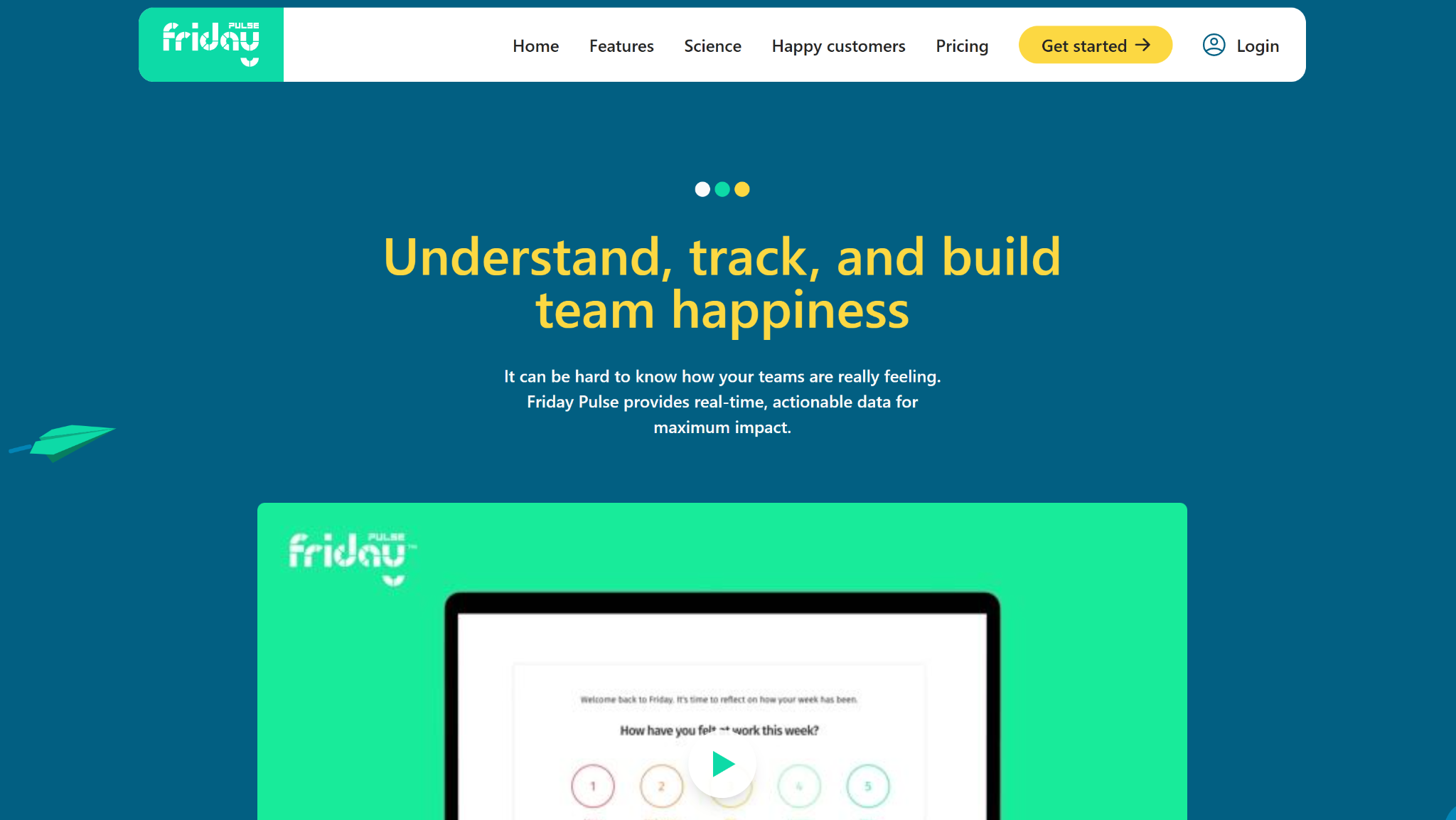
Friday Pulse takes a narrower approach than other tools on this list. It focuses on just one happiness KPI scored on a 100-point scale. It gives teams one signal to watch over time instead of waiting for a once-a-year survey to confirm what they already suspected.
The Culture Profile framework organizes feedback around Five Ways to Happiness at Work (Connect, Be Fair, Empower, Challenge, and Inspire), each mapping to research-validated drivers of workplace culture. Heatmaps help visualize these dimensions across teams, departments, and time periods, so leaders can identify which specific lever is driving a score decline rather than guessing at root causes.
The happiness data acts as an early warning system. The system has predictive risk assessments for burnout and turnover that flag risks based on score trends, so teams can step in before issues escalate. Managers also get curated conversation prompts based on score trends from the built-in discussion tool that help them start conversations more confidently.
Friday Pulse doesn't cover recognition, performance reviews, or goal tracking, so organizations that need those capabilities will run it alongside other tools. The research-rooted methodology is also opinionated by design, which means less flexibility to customize survey structures.
For organizations that are happy with a simple and consistent signal to track and believe sustained team happiness is a leading indicator of retention and performance, the tradeoffs are easy to accept. But remember that if leaders are unwilling to engage with that signal consistently, the value drops pretty quickly.
Friday Pulse pricing is tiered by survey cadence, with options for a one-off survey, a monthly pulse, or both alongside a weekly pulse. Pricing is per person, with discounts available for organizations with 100+ users.
No two organizations land on the same platform for the same reason. The right starting point is identifying which culture workflow is most broken on your team right now, and evaluating depth in that area before anything else.
The platforms in this guide cover four distinct workflows:
Most cover more than one, but few do all of them equally well. Trying to solve all four at once typically leads to a bloated implementation that nobody fully adopts.
Start by identifying your primary gap, then evaluate how well the platform handles it specifically:
Ask vendors to walk through your specific scenario rather than a generic feature tour during demos. If field employees consistently miss company news, watch how the tool delivers targeted push notifications on mobile and reports on actual open rates by location.
A culture platform only works if people open it consistently. Evaluate the specific mechanisms each tool uses to drive regular participation without requiring constant reminders from HR or IT.
The details that matter most here are often the smallest ones:
Don’t limit adoption tracking to login counts. Track adoption with daily active users by department, content engagement rates by type, and recognition participation frequency. These give you early warning when adoption is slipping in a specific team or location, before it becomes a cultural problem.
The strongest platforms automatically route survey results to the relevant manager with comparison benchmarks, showing how their team's scores compare against company averages and previous periods. This gives managers the context necessary to interpret and act on the survey results.
Look specifically for:
The platforms that handle this well treat post-survey action as a core feature, which means the workflow is built in rather than something your team has to engineer around the tool.
Your leadership team will eventually ask what the culture platform is actually doing for the organization.
Build your evaluation around the reporting depth each tool provides from the start. At minimum, you need exportable dashboards covering engagement trends over time, content reach by audience segment, recognition frequency across teams, and survey participation with longitudinal comparison.
Beyond that, governance capabilities become critical as headcount grows, so look for permission-based publishing that prevents unauthorized content from reaching company-wide channels, role-based access that restricts sensitive survey data to appropriate stakeholders, and audit trails that hold up during compliance reviews.
For organizations operating across multiple regions, confirm where the vendor stores employee data, whether they support region-specific retention schedules, and how they handle deletion requests. A platform accumulating years of employee sentiment data becomes a governance liability without documented GDPR or SOC 2 compliance your legal team can actually review.
Every platform in this guide solves a real problem. The question is whether the problem it solves is yours.
Survey-first tools deliver the most value when listening and follow-through are the gap. Recognition platforms work best when appreciation is inconsistent and manager-dependent. Enterprise communications platforms earn their cost when reaching every employee reliably across locations, languages, and devices is the primary challenge.
For organizations where culture programs exist but struggle to maintain momentum after launch, the gap is usually that participation requires a deliberate act. Employees have to remember to open a separate tool, HR has to keep manufacturing reasons to engage, and culture ends up feeling like an initiative rather than part of how the organization actually operates.
Jostle fits organizations where the goal is to make culture a consistent, felt experience rather than a managed program. When recognition, communication, and connection share the same space employees open as part of daily work, participation compounds naturally over time, and the people team spends less energy sustaining it.
Book a demo to see how Jostle works for your organization.

See why organizations are transforming their workplace culture with Jostle!


Read more by
Gabe Scorgie

Jostle’s employee success platform is where everyone connects, communicates, and celebrates at work. Find out more at jostle.me. © 2009–2026 Jostle Corporation. All rights reserved.